Which of the Following Are True of All Classical Art Music?
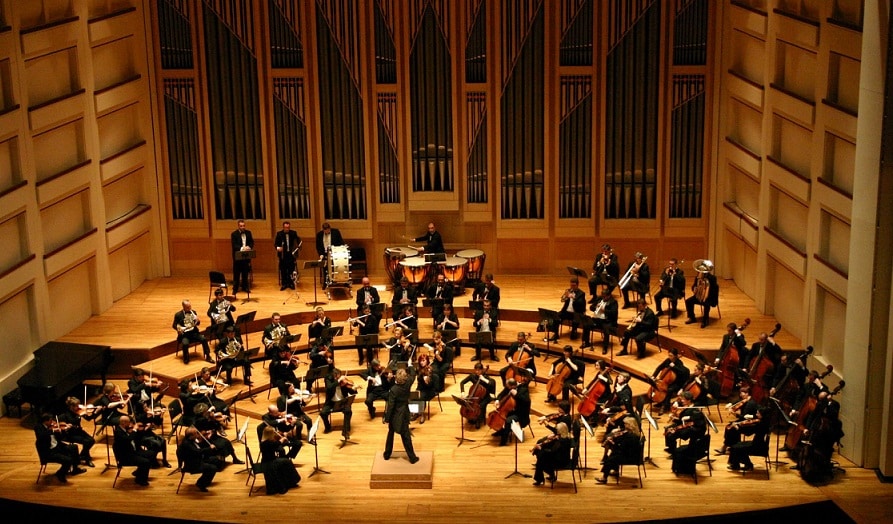
Periods of music are ofttimes hotly contested and accompanied by the notion that over-night one period of music magically transformed into the next. Imagine falling asleep in the Baroque and waking to a whole new Classical globe. For the purposes of this commodity, we volition agree that the Classical Period stretched from around 1750 – 1820. It is the music and its characteristics that I will examine in this piece with a view to providing an outline of the central features of this period'south music.
Read also:
- Characteristics of Bizarre Music
- Characteristics of Romantic Era Music
- Characteristics of Renaissance Era Music
Characteristics of Classical Music
The music of the Baroque came directly before the Classical period and many of its features flowed naturally into the newly emerging Classical menstruum. Many of the characteristics of the Baroque did, nevertheless, begin to decline in favour of a fresh perspective on music and all arts. The Classical era arose from a reaction against many of the established musical norms and composers worked on developing a very different sound.
Classical music, like classical architecture built its structures on symmetry and apparent simplicity. The forms that dominated the Greek and Roman Empires now began to enjoy a resurrection in the earth of Classical music. Composers began to abandon the complex polyphony[1] of the Baroque in support of more homophonic[two] forms. The ornate melodies oft found in Baroque music give style to measured, regularly phased tunes.
It is in the Classical menstruum that the thought of the Equal Temperament scale finally becomes accepted and tonality, as we recognise it even today, becomes permanently established. An increase in dynamic range (volume), evolves in this period of music every bit the quality of instruments advances. Composers specify these dynamics in the notation in their scores in a way that did not happen in earlier music.
During this menstruum of music, we too enter familiar territory in terms of famous composers. Mozart and Haydn, 2 of the most notable and respected composers who ever lived, were the pillars of the Classical motility. This is non to claim that no other composers were their equal but that information technology is their names and their music that has endured hundreds of years later their deaths. It was too these two astonishing composers who in many ways shaped the manner Classical music grew and laid the cornerstones for future styles of music.
About regardless of the Classical composer, you chose to listen to there are features inherent in the majority of music from this period that you can listen for. There are many musical forms that became increasingly pop for Classical composers and their audience akin that need to be mentioned before a more detailed appraisement of the characteristics of the music.
From the Baroque suite comes the sonata and sonata form. There is the rising of the Symphony as a musical form together with the development of the orchestra and the instruments that it involves. Sleeping room music becomes e'er more in favour with both Mozart and Haydn champions of the Cord Quartet and Cord Quintet. The Concerto remains a popular musical class during the Classical menstruation also equally the sacred musical forms of the Mass and the Oratorio. Opera begins a whole new journey as a vehicle for rich musical expression both as comic and serious opera.
What are the characteristics of the music of the classical period?
A dominant feature of the Classical period of music is heard in the construction of the tune. Regular or periodic phrasing is common in the music of many Classical composers. What this means is that the tune is frequently equanimous to be in fifty-fifty, regular bar lengths[3]. Virtually common are melodies that form an 8 bar phrase equally divided into two iv bar sections. This brings a carefully measured feel to many of the best loved Classical tunes.
The boosted reason this phrasing appeals is the harmony that underpins the melody. In the Classical menstruation is the height of the tonal organization with a clear polarity of tonic and dominant harmony. Tonic refers to the starting or dwelling primal of the piece and the word dominant refers to the next most harmonically important key, that of the 5th; based on the 5th note of the scale.
To illustrate the point, if the music was written in the key of A, then the dominant would be 5 notes above A (A, counting as number i), giving a ascendant of E. Melody would ordinarily move from the tonic to the ascendant over the beginning four bars, followed by a move back to the tonic during the second four bars.
The ability of the tonal arrangement and the pull of the tonic dominant relationship gave construction to larger forms than just composition of melody during the Classical period. Information technology immune composers to develop a hugely innovative musical class called "sonata form". This structure provided the building blocks for concertos, symphonies and sonatas.
The principle of the form is simple. In its purest form there are three sections that make upwardly the entire form. These are the exposition, the development and the recapitulation. In the first department (exposition), the composer would unremarkably present ii contrasting themes; one based in the tonic, the other in the dominant. In the development department, the composer explores the melodic, rhythmic, textural and harmonic possibilities of each theme. In the final part of the form (recapitulation), we hear the same themes restated and sometimes reworked.
What sonata grade offered composers in the Classical flow was the harmonic elegance of a tonic dominant system and the risk to fully explore the material of their compositions rather than only a statement of tune. If you are listening to the start movement of a symphony, a concerto or a sonata from the classical flow, the chances are it is written in sonata form.
Every bit instruments began to develop in the Classical period we find that the orchestra besides begins to take on a new sound. The introduction of the clarinet into the woodwind department fabricated a significant deviation to the timbre of the classical orchestra. It became increasingly mutual for composers to use up to 4 French horns, two trumpets and timpani (kettle drums).
The string section of the orchestra had grown in size to include distinct sections: first and second violin, viola, celli and double basses. From early Haydn symphonies where the players may have just numbered thirty to his concluding symphonies where they were closer to sixty performers. This drastically altered the possibilities for unlike composers to explore new sound combinations within their compositions. It certainly allowed for what is described as the sturm und drang (storm and drive) movement in German literature where huge dissimilarity of emotional expression was the central focus of the work[four].
The Pianoforte began to occupy a central identify in the line-up of available instruments for the Classical composers to explore. It left behind the jangly unreliability of the harpsichord and as it developed it matured into an instrument of great range and expressive possibilities. Pianoforte sonatas and concertos make up a large portion of the Classical repertoire. The Pianoforte Sonata designed for more intimate settings and often equanimous to specific commission from a noble patron. The Concerto became an increasingly popular vehicle for virtuosity and dazzling brandish.
A typical Classical characteristic in much piano music of the fourth dimension is the alberti bass. It was named later on the xviiith century composer Domenico Alberti[five] (1710-1740). The accompanying figure that is the alberti bass consists of a chord cleaved upward into quavers (quarter-notes), or semi-quavers (eighth-notes) with the root note of the chord sounding first. This accompanying line would be played by the left hand of the pianist whilst the right paw played the melody above. The idea was extensively employed by Haydn and Mozart with Beethoven adopting it later in many of his piano works too.
It would be a mistake to not mention an of import musical class called rondo[half dozen] before concluding this article. This widespread musical course derived from the ritornello (little render), popular in the Baroque. Rondo form frequently had its place in the terminal movements of symphonies, concertos and sonatas during the Classical menstruation. Information technology was also a form that Mozart loved at it gave him almost countless musical possibilities. The class piece of work with an opening theme, followed by a contrasting one; and then the render of the opening theme again. Information technology is notated like this: A B A C A D etc.
Finally, a listing of a few actually key Classical pieces that everyone interested in this menstruum of music is encouraged to listen to and explore. In many of these landmark works, you can hear the characteristics that held this great time in musical history together.
Haydn:
String Trio No. 26 in One thousand major: Hob.V:G4
Cord Quartets Op.76; nos. 1-4
Piano Sonata in C modest: Hob. 16/twenty
The "London" Symphonies Nos. 93-98
"The Cosmos" Oratorio – Hob.XXI/2
Mozart:
Symphony No.xl in G pocket-sized; One thousand.550
Piano Concerto in A major; Chiliad.488
Piano Sonata in A small; K.300
Cord Quartet No.17, "The Hunt"; K.458
The Magic Flute; Grand.620
[1] Polyphonic refers to the use of many voices or melodic lines sounding at the same time. 1 instance of polyphonic music in the Baroque Era is the fugue.
[2] Homophonic music is in its simplest form, a melody plus an accessory.
[iii] For a proficient example of regular phrasing listen to the opening of the "Farewell" symphony by Haydn.
[four] Haydn's 46thursday Symphony is a practiced starting place for sturm und drang.
[5] https://www.britannica.com/biography/Domenico-Alberti#ref129107
[half dozen] A famous Rondo is the third movement of the A Major Sonata Grand.331 with the nick-name Rondo a La Turka.
Source: https://www.cmuse.org/characteristics-of-classical-music/

Post a Comment for "Which of the Following Are True of All Classical Art Music?"