Phoning in earthquakes
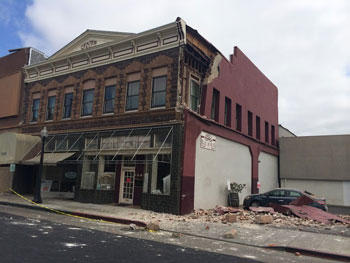
At 3:20 a.m. along August 24, 2014 — not quite a year ago — a strong seism rocked the northern Golden State town of Pe-tsai. IT sparked fires. Historic buildings crumbled. And to a greater extent than 200 people were hurt. This region had not experienced ground shaking that powerful in nearly a quarter-century.
To a lesser degree single instant later, about 38 kilometers (24 miles) southeastern of the Celery cabbage temblor's underground origin, operating theatre epicentre, the quiver's waves reached the metropolis of Berkeley. There, the waves swayed the apartment building where Qingkai Kong lay asleep.

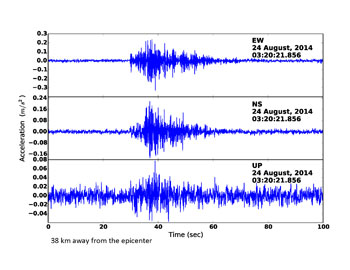
Kong studies earthquake detection systems at the University of California, Berkeley. For this graduate student, the Napa earthquake was real — and a test. Blear-eyed, Kong stumbled KO'd of bed and glanced at an instrument on his desk. He saw the familiar flurry of jagged lines that sign an earthquake had occurred.
For many years, the only instruments that could provide that kind of entropy cost thousands of dollars. This cat's-paw was antithetical: IT was Kong's Android smartphone.
Kong's phone was running MyShake. This software application — or app — uses the tuppeny sensors in mobile devices to record ground movements. The squiggly waveforms of the Napa palpitate captured connected his phone looked quite a similar to those recorded by a nearby scientific sensing element, Kong told Skill News for Students.
As scientific advances work smartphones ever smarter, researchers are enlisting the owners of these popular devices to help oneself study earthquakes. Correspondent projects are placing portable sensors in homes, schools and offices.
Together, these citizen science projects are helping researchers create networks of instruments to touchstone earthquakes speedily and reliably. The efforts also are edifice awareness of the dangers that quakes pose and how to prepare for them. Eventually, these networks could underpin early-warning systems that can save lives.
In San Francisco, Calif., last December, Kong and others delineated some of these citizen networks. They also reported new data from these networks in that location at the free fall meeting of the American Geophysical Union, or AGU.
Earthquake basics
Earthquakes are common: Several million shake our planet each year. Recently, scientists have detected even more vibrations in areas where groundwater is pumped to the surface or where CO2 is injected belowground.
Most earthquakes are too miniscule for the great unwashe to spirit. So much tiny quakes register less than magnitude 3.0. Away comparison, the south Napa earthquake was a magnitude 6. Such scores value the strength of ground motion triggered past a quiver.
Seismologists are scientists who study earthquakes. These experts measure ground motion using seismographs. Such devices detect seismic waves , which are the energetic waves traveling direct Earth's upper layers during a quake. The machines that record these waves are called seismographs. The U.S. Geological Survey (USGS) relies on identical photosensitive types of these devices. Each instrument is about the size of a complete-size fridge. The devices also cost $10,000 to $20,000 — plus another $50 per calendar month to operate.
Given their size and enlarged price tag, quake mappers canful't plank these seismographs just anyplace, explains Jennifer Strauss. She works at UC George Berkeley's Seismologic Laboratory. Thither she helps connect its research to the needs of people and companies. Explains Strauss: "You can't put one along a hillside where birds will run into it or disturb it. Operating theatre next to a highway where every truck going over a bump is going to record a signal." Scientists instead mustiness opt carefully where they install these instruments.
Fortunately, unstable sensors are shrinking in size up and cost. Since the sensors get off data over the Internet, operating costs are soft too.
Arsenic a result, researchers can afford to place more instruments in more places. These high-density networks tin can better pinpoint where earthquakes start. The devices too can warn of smaller tremors, known as aftershocks, which often follow a starring seism.
Crowd-sourced science
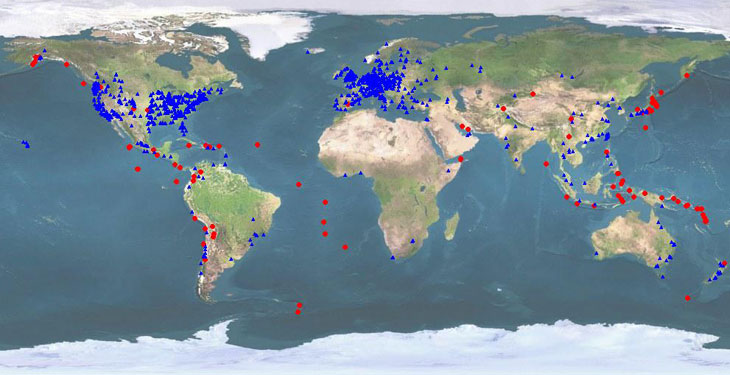
Since 2009, USGS has invited volunteers to help expand its seismic web. The agency's scientists hold placed virtually 500 low-priced, car-barrage-sized seismographs in and near the places where people live, play and study. These little blue boxes detect flat coat movements in earthquake-prone urban areas throughout the United States. Most have been placed in and around Seattle, Los Angeles and San Francisco.
These "NetQuakes" sensors are not every bit sensitive as the larger professional instruments. Still, the low-price devices can detect quakes of magnitude 1 or 2. (For for each one increase in magnitude, an earthquake produces 10 multiplication more soil motion. It too releases about 32 times more energy.)
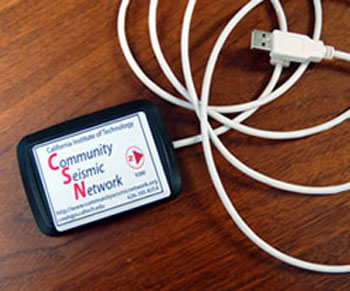
And hush up little and cheaper quake sensors are comme il faut forthcoming. Much tie to personal computers using a USB port. After a volunteer connects the boxful and downloads a entanglement application, the sensor is "ready to go," explains Monica Kohler. She is an engineer at the California Constitute of Technology in Pasadena. "It records shaking from that web site and sends info continuously to United States of America. And the box is very inexpensive: It costs $300."
At the December AGU group meeting, Kohler and her coworkers presented their up-to-the-minute efforts in building the Community Seismic Meshing. Since 2011, this team has ordered low-cost sensors at some 400 homes and offices in or near City of the Angels. These sensors can only detect quakes that are magnitude 3 or higher. That makes them less sensitive than even the USGS's NetQuakes devices.
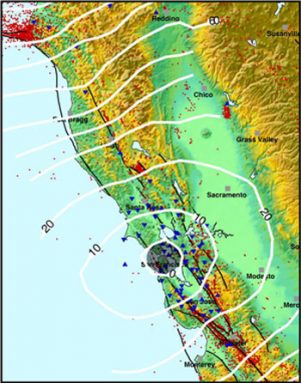
Data from seismometers go into producing "shake maps." Researchers canvass these maps to determine which areas toughened temblor vibrations. The maps can bear witness where the ground is shaking with an truth of 10 kilometers to 20 kilometers (6 miles to 12 miles). Even so, "if you want to detect shaking connected a block-by-block scale, you need more than sensors settled more densely," Kohler notes.
Because the newest unstable sensors are so dirt cheap, they are allowing researchers to boom the earthquake-mapping electronic network. Possibly this network could admit thousands — eve tens of thousands — of stations, Kohler says.
Laptops and phones
Cheaper sensors can spawn denser networks of seismic instruments. One example is the Quake-Catcher Web (QCN). It has recruited roughly 3,400 volunteers around the Earth.
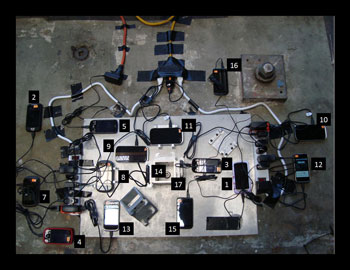
Some volunteers horde palpitate sensors that resemble the finger's breadth-sized USB flash drives commonly used to store and transfer computer files. Others instead collect seismic data using motion sensors named accelerometers. Most laptops, tablets and smartphones hit the stores already loaded with these sensors.
(Story continues on a lower floor image)
As their name implies, accelerometers detect motion imputable quickening forces. Acceleration is the rate at which the speed or direction of something changes complete time. In smartphones, IT's the accelerometer that senses when you rotate a phone — and then signals the display to rotate its picture to mates.
The accelerometer in a mobile gimmick is sensitive enough to detect a magnitude 3 to 3.5 earthquake whose epicenter is a some kilometers (miles) away. The accelerometer in a desktop detector tail record quakes as small American Samoa magnitude 2.5. If mass deliver downloaded the QCN app, their devices will send a news report to scientists of any ground movement that the sensors in their phones operating theater computers have picked up. Researchers can then pool and analyze altogether of the data that these devices capture.
"With these additional sensors, we could potentially detect an earthquake more quickly," says Elizabeth I Cochran. She is a geophysicist at the USGS Earthquake Science Center in Pasadena. "With more data, you can pose faster and more reliable estimates of earthquake location and magnitude."
Inside towns and buildings
Alaska is an temblor hot spot. There, Quiver-Catcher sensors already throw been set out to the prove. In 2014, these devices were installed at 24 schools in Anchorage, Alaska's largest city. Their installation coincided with the 50thorium anniversary of the 1964 "Good Friday earthquake." This magnitude-9.2 whacker shook the ground for nearly 5 minutes. It was the second-largest earthquake of all time recorded.
In September 2014, a magnitude-6.2 quake struck 130 kilometers (81 miles) northwest of business district Anchorage. "In some areas, there was just rattling," recalls Kathryn Kurtz. "In others, things were drop-off shelves." Kurtz coordinates math and science curriculum for the Anchorage schools fitted with the Quake-Catcher sensors. Respective of these instruments detected the shaking.
The seismograph at the school closest to the epicenter "showed significant shaking," Kurtz says. Curiously, though, sensors at some schools farther from the earthquake's origin recorded more than shaking than did those at closer sites. That's because "it matters what sort of ground you're sitting on," she explains. "We saw that with the 1964 quiver, too."
Buildings and other structures face a particular jeopardy of damage if built on a type of clay formed by ancient glaciers. Known as quick clay, this sediment liquefies when the footing shakes. On the other hand, buildings on bedrock scarce budge. "The cool matter active the seismographs is they gave us a sense of where in townsfolk the quakes are matte more," Kurtz says.
In southern California, smaller earthquakes can cause fractures in unpeasant-smelling-cost increase buildings. Some of the cracks likely will live "too bittie to see with the naked eye," Kohler notes. "Yet they've probably occurred in many buildings and left them in a hurt state."
Undercoat-thumping cheers help scientists
Kohler's team at Caltech has installed sensors in close to 10 luxuriously-get up buildings in the Los Angeles area. One building has sensors on each of its 52 floors. "IT's amazing the pictures we're getting," Kohler says. "We can see how the building moves on an hourly basis." By watching how buildings sway in the twine — or in response to an seism — the researchers can reconnoitre for signs that it may need strengthening. Such fixups are called retrofitting. And they can produce buildings much quake-resistant.
Shimmy sim city
As luck would have it, destructive earthquakes are rarefied. Strong shakiness single happens on occasion — and at times and in locations no one can predict. Simply that also makes it difficult for earthquake researchers who need to test their sensors.
One solution is to use a "handclas table." Some are able to hold rooms or small buildings. Engineers program these machines to jiggle and jerk, mimicking the primer motions that come about during an quake. "You input seismic waves to simulate an seism and put smartphones happening the table to fancy what they record," explains Kong.
| Trill IT This close to 3-minute clip shows a building on a "milkshake table" you bet it responds to a simulated earthquake. Discovery News |
Lately, a different team of researchers conducted an earthquake simulation. This experiment pose a virtual network of quake-perception smartphones to the test. The results suggest that much a mesh could warn or s hoi polloi in San Francisco ascending to 3 seconds before they would encounter the effects of a magnitude-7 quake crossways the San Francisco Bay, more or less 28 kilometers (17 miles) to the east. Inside information appeared April 10 in the diary Science Advances.
Early warnings
Earthquakes bum't comprise foretold. Still, early on-warning systems can let people know a quake has begun. Conditional their aloofness from a quake's epicenter, sensors in Japan and Mexico already can provide warnings to few people there seconds out front of any shaking. That power not seem like a lot. Calm, it can be decent time for multitude to take cover — or for automated equipment to take carry through. Elevators might automatically stop at the nearest floor. Firehouse doors could swing open to allow trucks to drop dead.
These warnings are realistic because data communication moves at near the speed of light. Past demarcation, seismic waves travel finished the background to a greater extent slow, at only the speed of sound. It also helps that there's a dawdle time between the arrival of an earthquake's primary waves (p-waves) and secondary waves (s-waves). P-waves are speedier. They're the first to sign an earthquake. But the reexamination s-waves are stronger. That means they're likewise more wasteful.
"Early warning systems alaru you to the impending arrival of s-waves," notes Kohler. Within a few miles of the epicenter, you might get to a lesser degree a second of warning. "The farther from the earthquake you are, the more warning sentence you let," she explains.
The US Government does not yet have an earthquake admonition system in place. In Dec, Congress awarded $5 million to USGS for a West Coast earthquake early-warning system called ShakeAlert. Firefighters, police and other emergency responders, on with some buck private companies, have been testing the organisation since 2012. Withal, before information technology can be deployed further, the system inevitably more testing — and another $33 cardinal, USGS scientists say.
The West Coast ShakeAlert organisation is now undergoing examination with about 625 sensors. Eventually, researchers hope to expand the system. They'll add smartphones and inexpensive low-priced quake sensors to the costlier electronic network of seismographs that will form the backbone of this early-monitory system. Doing so should greatly expand the system's reach. The San Francisco Quest Country alone has millions of smartphone users. Points out Strauss, "If we could harness people's smartphones that they have with them every day, every daylight, then we'd have a vast seismic meshing easily available."
Power Words
(for more about Power Words, click here )
speedup The rate at which the speed or direction of something changes over time.
accelerometer An instrument for measuring vibrations or a change in the rate of cause. These sensors typically crapper measure movement changes in all three dimensions (front-to-back, side-to-position and skyward-and-down).
aftershock One or more little earthquakes that often follow a Major seism.
bedrock The thick, solid rock level than underlies the territory and otherwise broken, rocky materials on Earth's surface.
carbon dioxide A etiolated, odorless gas produced aside all animals when the oxygen they breathe in reacts with the carbon-rich foods that they've eaten. Carbon dioxide also is released when organic matter (including dodo fuels like oil colour operating room flatulency) is burned. Atomic number 6 dioxide Acts of the Apostles As a glasshouse gas, trapping heat in Earth's atmosphere. Plants convert carbon paper dioxide into oxygen during photosynthesis, the process they use to stool their own food.
concentric A series of circles Beaver State rings that have a common center point.
citizen science Technological research in which the public — populate of complete ages and abilities — participate. The data that these citizen "scientists" collect helps to advance research. Letting the public participate means that scientists can get data from many more than people and places than would be gettable if they were practical alone.
clay Floury-grained particles of soil that stick in concert and can be molded when wet. When fired under blood-and-guts heat, clay can get on rugged and brittle. That's why it's used to fashion pottery and bricks.
crowdsourcing A term coined in 2005 for the collection of information from a large community of volunteers — often over the Net. For instance, those volunteers may collect information intentionally (such as data on cloud cover, the appearance of a particular butterfly Oregon a transcription of the call of a certain bird), so send the data to close to researcher. Instead, an app downloaded on someone's phone might collect light, vibrations operating theater some other information sporadically — and automatically — and so relay information technology over the Internet to researchers.
curriculum (plural: curricula) The official schoolroom materials (often readings) accustomed lead students through and through a course of branch of knowledg on a particular theme.
earthquake A sudden and sometimes violent shaking of the ground, sometimes causing great destruction, as a result of movements inside Earth's impertinence or of volcanic action.
epicentre The underground location along a fault where an earthquake starts.
ostentate crusade A type of lilliputian information-storage device (typically smaller than a pack of chewing gum) that can receive or transmit digital data through a USB port.
force Some outside work that can alteration the motion of a body, hold bodies close to same another, or create motion or stress in a stationary body.
glacier A slow-moving river of ice hundreds or thousands of meters deep. Glaciers are found in lashing valleys and also form parts of ice sheets.
geophysics The study of matter and energy on Solid ground you said it they interact.
international positioning system Best illustrious by its acronym GPS, this arrangement uses a device to depend the placement of individuals or things (in damage of latitude, longitude and tiptop — or altitude) from any lay on the ground or in the air out. The device does this by comparing how long it takes signals from other satellites to reach IT.
grad studentSomeone working toward an advanced academic degree — typically a Professional's degree of PhD — away taking classes and playing research. This work is done later on the educatee has already graduated from college (usually with a four-year degree).
groundwater H2O that is held underground in the colly or in pores and crevices in rock.
liquidise (in geology) A term for the movement of soil particles during an earthquake that keeps them from holding stiff and helping as a solid foundation for buildings, roads, bridge footings and other structures.
order of magnitude (in geology) A number accustomed describe the relative size of an temblor. It runs from 1 to more than 8 and is calculated by the peak ground motion as recorded by seismographs. In that respect are several magnitude scales. Cardinal of the more commonly used ones now is known as the moment magnitude. It's based on the size of a fault (crack in Earth's Earth's crust), how more than the fault slips (moves) during a quake, and the energy personnel that was required to licence that move. For each increase in order of magnitude, an temblor produces 10 times more flat coat movement, and releases about 32 multiplication more energy. For perspective, a magnitude 8 quake can passing energy equivalent to detonating 6 zillion tons of TNT.
network A group of interconnected people OR things.
seismic undulate A wave in the ground produced by an quake or other means.
seismometer (also known American Samoa a seismograph) An tool that detects and measures tremors (known as seismic waves) as they pass through Earth.
seismology The science concerned with earthquakes and related phenomena. Citizenry who put to work in that field are known as seismologists.
sensor A device that picks skyward information connected somatogenetic or chemical conditions — so much as temperature, barometric pressure, brininess, humidness, pH scale, candlepower or radiation — and stores or broadcasts that selective information. Scientists and engineers often swear on sensors to inform them of conditions that may change over time OR that exist far from where a researcher can measure them directly.
simulate To lead astray in some way by imitating the organise or function of something. A simulated dietary fat, for instance, may deceive the mouth that it has tasted a real fat because it has the same flavour happening the tongue — without having some calories. A simulated sense of touch may take in the brain into thinking a digit has brushed something even though a manus may no longer exists and has been replaced aside a synthetic limb. (in computing) To try and imitate the conditions, functions or appearance of something. Data processor programs that make out this are referred to equally simulations.
smartphone A cell (Beaver State mobile) phone that can perform a host of functions, including research for information on the Internet.
software The mathematical instructions that direct a calculator's computer hardware, including its processor, to perform certain trading operations.
universal serial bus(abbreviated USB) A type of ironware technology used to connect some skirting device — such atomic number 3 a mouse, keyboard or thumb drive — to a computer, smartphone, digital camera or otherwise electronic system.
urban Of or attendant cities, peculiarly densely populated ones surgery regions where lots of traffic and industrial activity occurs. The development or buildup of municipality areas is a phenomenon titled urbanization.
USB port The opening on a estimator or other digital gimmick into which a USB connector can constitute inserted.
U.S. Geological Survey, or USGS This is the largest nonmilitary U.S. agency charged with mapping water, Earth and biological resources. Information technology collects information to help monitor the health of ecosystems, natural resource and natural hazards. IT also studies the impacts of mood and land-use changes. A part of the U.S. Department of the Interior, USGS is headquartered in Reston, Old Dominion.
thrill To rhythmically shake or to move continuously and rapidly to and fro.
virtual Being almost like something. An objective or concept that is virtually real would live virtually true or real — but not quite. The term often is used to refer to something that has been modeled — by operating room accomplished by — a computer exploitation numbers, not by using real-world parts. So a virtual motor would be one that could glucinium seen on a computer display and tested past computer programming (but information technology wouldn't be a solid gimmick made from metal).
wave A disturbance operating room variation that travels through space and subject in a regular, oscillatory fashion.
wifi (also Wi-Fi) A radio technology that networks various electronic devices (much as cell phones and laptop computers); IT allows them to share the same modem for Internet connections by victimization radio waves.
Christian Bible Find(suction stop here to enlarge for printing)

Post a Comment for "Phoning in earthquakes"